 Miravo
Hot Water boiler
Model an industrial hot water boiler with firing state, thermal lag, pressure response, runtime health, and fault behavior.
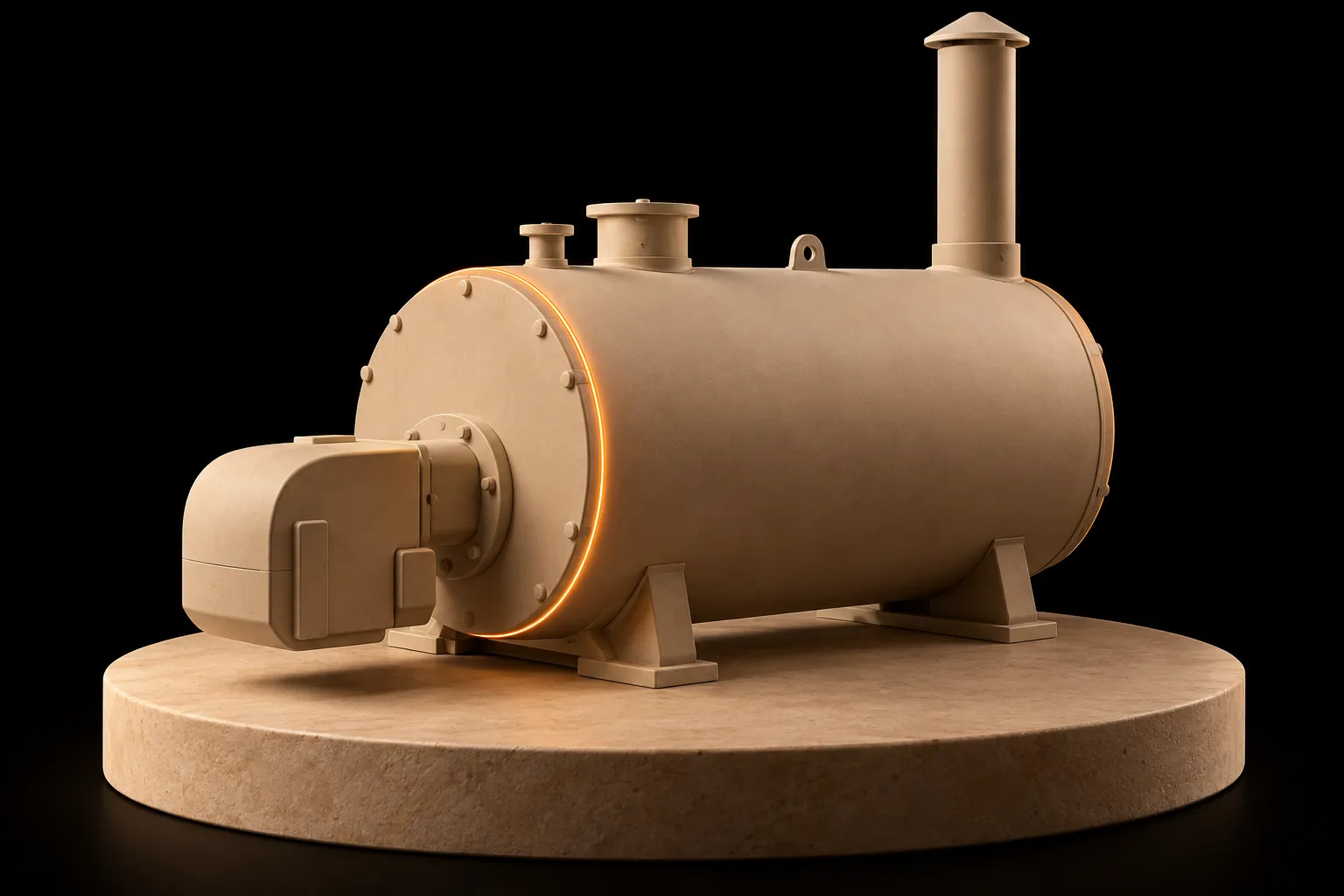
What it is
An industrial hot-water boiler with a modulating firing rate, thermal lag between firing and supply temperature, system pressure and combustion indicators. Pair it with a circulation pump and a heating loop to model a heating plant.
Used in
commercial-building: the central heating plant, with a loop circulation pumpdistrict-heating: three gas boilers in the heat plantpharma-cleanroom: a stand-in for a clean steam generator
What it tracks
| Member | Description |
|---|---|
running | Boiler operating state. |
firing_rate | Modulating output as a percentage of rated capacity. |
supply_temperature | Delivered water temperature. It regulates to supply_temp_setpoint_c while firing and cools toward ambient when stopped. |
return_temperature | Loop return water temperature, tied to the circulation pump. |
system_pressure | System pressure, which changes with temperature. |
flue_gas_temperature | Flue gas temperature, an indicator of combustion efficiency. |
fuel_flow | Live burn rate. |
fuel_consumed_total | Cumulative fuel used. |
co_emission | CO in the flue gas, in ppm. |
circulation_pump_running | Derived from circulation_pump_tag > 0.5. It does not interlock firing. |
runtime_hours | Lifetime counter. |
Startup
A running plant boots at its setpoint: supply_temperature starts at supply_temp_setpoint_c and return_temperature 4 K below it, for any setpoint. After Stop the water cools toward 22 °C, and Start then ramps back up from ambient (tau 90 s) like a cold boiler.
Fault modes
scale_buildup: needs the degraded stage and flue gas above 240 °C. Supply temperature falls ×0.93 and fuel flow rises ×1.08 for 900 s.flame_instability: needs firing rate above 5 % and CO above 30 ppm. Flue gas temperature spikes ×1.2 and CO rises 15 ppm for 200 s.circulation_pump_failure: needs the degraded stage and pressure above 3.8 bar. The pump tag drops to 0 and pressure falls 0.35 bar for 180 s. It does not stop firing or run the supply temperature away.
Key parameters
| Parameter | Default | Unit |
|---|---|---|
rated_output_kw | 500 | kW |
rated_pressure_bar | 3 | bar |
supply_temp_setpoint_c | 80 | °C |
return_temp_design_c | 60 | °C |
min_firing_pct | 0 | % |
efficiency | 0.92 | pu |
supply_temperature holds supply_temp_setpoint_c (within about 1 K, 90 s thermal lag) whenever the boiler is firing, whatever the firing rate. Firing rate follows the daily demand schedule and sets fuel burn, not temperature. When firing stops, supply cools toward ambient (about 22 °C).
min_firing_pct is a floor on the scheduled firing while the boiler is running. At 0 the schedule drops to zero from 22:00 (the commercial-building night setback), so supply falls overnight. Set it to a base load such as 40 for a plant that holds its supply temperature around the clock, like the district-heating plant.
Use cases
- A central heating plant with thermal inertia.
- Cascade fault scenarios with a circulation pump.
- Combustion efficiency trending and scale-buildup detection.
- Building heating-system analytics.
Customize
miravo models add hot-water-boiler --from hot-water-boilermiravo models inspect hot-water-boilerWas this page useful?
Last updated on
HVAC rooftop unit
Cooling-focused commercial rooftop unit with occupancy and compressor state, mixed-air blending, and fault health.
District heating substation
District heating customer substation with a heat exchanger, pipe transport delay from the plant, seasonal weather-driven demand, energy-balance primary flow, and fault health.